
More approvals, more problems? Rethinking the housing pipeline
6 min read
Key takeaways
Approvals are not the problem; delivery is. With 219,000 homes already under construction and completion times ballooning, the real bottleneck lies in the build phase, not planning reform.
While state and local governments focus on approvals and improving the feasibility of new projects, building companies continue to be stretched thin across an already swollen pipeline and reducing margins.
With completion times already above average, and construction costs elevated, it seems an odd time to be incentivising more dwelling approvals and commencements to the backlog of work to be done.
Ahead of the National Productivity Summit, the analysis proposes it’s time to shift the policy focus from demand stimulation and approvals to sustainable, scalable delivery—before turning up the tap on a system already at capacity.
While state and local governments focus on approvals and improving the feasibility of new projects, building companies continue to be stretched thin across an already swollen pipeline and reducing margins.
From the very announcement of the National Cabinet’s plan to build 1.2 million new homes in five years in August 2023, many in the industry thought it was unachievable.
The core of the problem with any government target for new dwellings is that government can’t influence many of the factors that determine demand and supply.
While state and local governments focus on approvals and improving the feasibility of new projects, building companies continue to be stretched thin across an already swollen pipeline and reducing margins.
Looking at the construction pipeline shows that policy change is urgently needed in the enablement of quality construction, rather than new dwelling approvals.
The lessons of 2019
The closest Australia came to 1.2 million dwelling completions in 5 years was at the end of 2019.
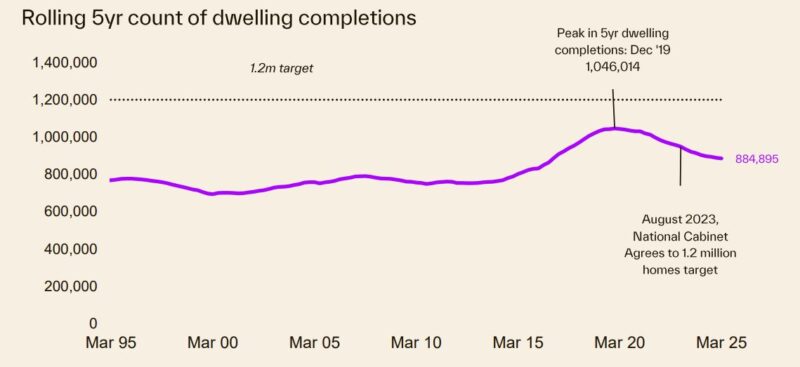
This was largely because the market was very different to what it is now:
The cash rate averaged 1.6%, as opposed to the average 4.18% since July 2024.
Units made up an average 46% of approvals in the 5 years to 2019, as opposed to 37% in the past five years, so dwelling completion was more scalable.
Investors made up a bigger part of demand, supporting a lot of presales in off-the-plan apartment development.
ABS data shows investors peaked at 44.8% of new housing finance in the June quarter of 2015 nationally, and 55% in NSW.
Foreign investment in new residential properties was higher, with NAB reporting foreign buyer purchasers of new homes holding above 10% through much of the 2010s.
While a lot of new dwellings were completed, this did not necessarily lead to good housing outcomes.
Home ownership rates fell between June 2014 (67.2%) and June 2020 (66.2%), capital growth outcomes for investors have generally been very poor for 2010s apartments, and defects were so rife that some new dwellings could not even be lived in.
More dwelling completions are not necessarily a mark of success for the Australian housing landscape.
State governments can bring us to water, but markets make us drink
Fast forward to the 2020s, and some lessons were clearly learned from the 2010s.
Lending is more prudent, build quality is better, and new apartments are geared to larger floorplans with owner-occupiers in mind.
To move the dial on the numbers state and local governments have enacted changes to speed up planning and approval processes and increase new home purchases.
Recently, the NSW government has released a pattern book for approved designs, implemented sweeping upzones for more density, and flagged presales finance guarantees for eligible developers.
Victoria has seen similar sweeping upzones, is offering substantial stamp duty concessions on off-the-plan strata homes, and the Queensland government has also signalled initiatives to streamline development approvals.
Despite these changes, dwelling approvals have generally remained very low.
Why? This is in part because of relatively high interest rates, affordability constraints, and new purchases being brought forward under the HomeBuilder Scheme (which was overlaid with other incentives such as the then recently introduced First Home Guarantee).
Buyers may also be lacking confidence in new builds following a surge in construction costs between 2021 and 2023.
Total dwellings approved averaged 15,611 per month over the year to June, down from the decade average of 16,770, and well below the average 20,000 needed for 1.2 million homes in five years.
That being said, there was a big jump in unit approvals through June, surging 34%.
However, this has occurred against a 50-basis point cut in the cash rate, and follows a sharp drop in April.
State and local governments can influence dwelling approvals, but interest rates are an extremely important factor as to whether there is market demand for new housing and whether developers will seek approval for new projects.
Unit approvals are averaging about 7,000 a month, but this is well below the peak found through the more favourable market conditions of the 2010s (when monthly unit approvals peaked at almost 13,000 in November 2017).
Early stages are not where the focus is needed
Approvals could move higher in the coming months, as recent zoning reforms and incentives for new builds at the state level coincide with falling interest rates.
But this could present a problem for the construction industry: it may add more new projects to an already swollen pipeline.
It’s like turning up the tap on a bath that is already full.
Building activity data from the ABS shows there were just over 219,000 dwellings under construction in the March quarter of 2025, and a further 30,000 dwellings that have been approved, but have not yet commenced construction.
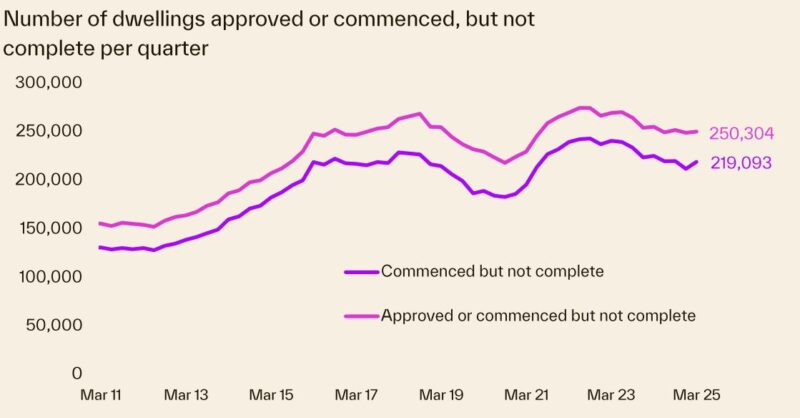
While the number of dwellings in the pipeline commenced and not complete is not too dissimilar with the rise in the 2010s, it has been associated with an irregular increase in time to complete dwellings, an increase in construction costs, and other capacity constraints which is not seeing that volume trend down as quickly as it did between 2018 and 2020.
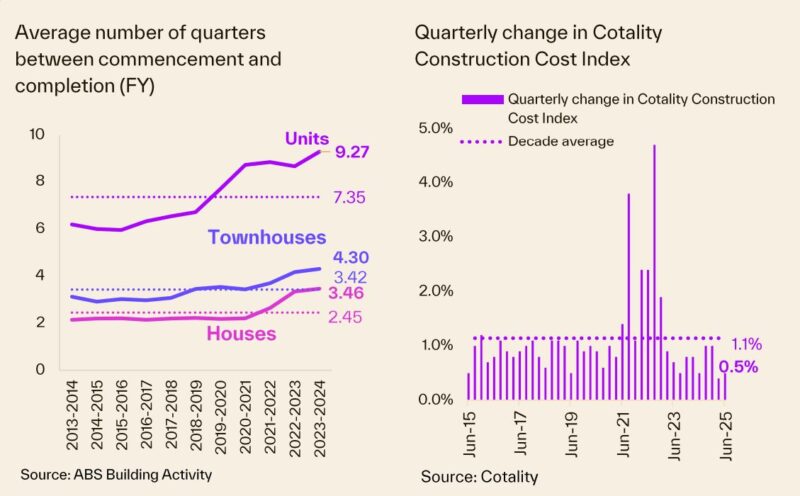
Effectively, dwellings are being approved but getting ‘stuck’ in the commencement and construction phase.
With completion times already above average, and construction costs elevated, it seems an odd time to be incentivising more dwelling approvals and commencements to the backlog of work to be done.
In fact, without increasing the capacity or productivity within the construction sector to take on this additional work, it could even present an upside risk to inflation, at a time when the industry is crying out for rates to move lower.
What can the government really do about housing supply?
Perhaps the priority for government policy then should be on delivering the pipeline, rather than adding more to it.
Improvements to productivity are rightfully getting a big callout, with the Productivity Commission estimating a 12% decline in dwelling construction gross value added per hour between the mid-90’s and 2023.
Making homes faster and cheaper to build, while still maintaining quality, resilient homes is the key challenge for policymakers to focus on right now.
Another consideration is the demand side of the equation, which has lost some focus in recent years.
Winding back negative gearing and capital gains tax concessions for residential property, implementing broad-based land taxes or including the family home in the pension asset test are all examples of policies that could reduce demand for housing, and potentially the need for as much new supply altogether.
This would have the added benefit of easing capacity in new home construction, rather than risking more inflationary pressures for new housing construction.
All eyes now turn to the National Productivity Summit, where leaders across government, industry and unions will debate the very reforms that could reshape elements of both supply and demand.
With calls mounting to revisit negative gearing, capital gains tax concessions, and other structural incentives driving housing demand, the conversation is finally shifting beyond approvals and into the real levers of change.
If governments are serious about delivering 1.2 million homes, they must focus on building capacity, lifting productivity, and ensuring every approved home actually gets built.