Bispecific competition, debating oral SERDs and a bold GLP-1 prediction
5 min read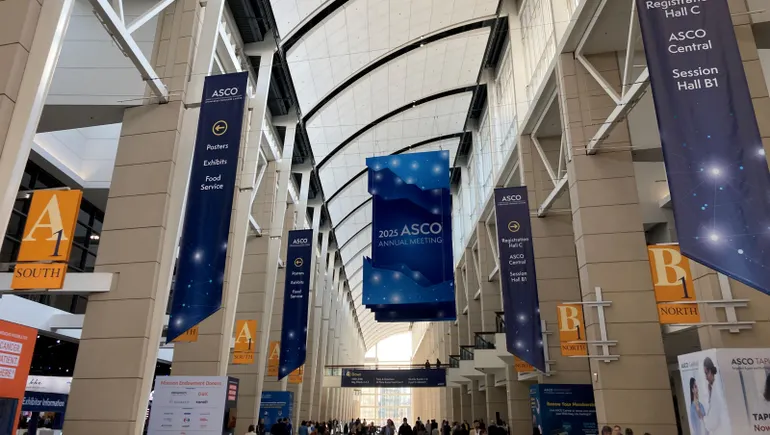
CHICAGO — The American Society of Clinical Oncology’s annual meeting is a forum for data. On Monday, it was also the backdrop to oncology’s latest deal, when Bristol Myers Squibb and BioNTech announced a multibillion-dollar alliance around a newly in-vogue drug.
BioNTech’s drug is a bispecific antibody that simultaneously targets the proteins PD-L1 and VEGF. Pharmaceutical companies like Bristol Myers are increasingly enthusiastic about drugs of this type, following startling data in lung cancer from partners Akeso and Summit Therapeutics last year.
Bristol Myers will now co-develop BioNTech’s version, which BioNTech gained in a 2024 acquisition of Biotheus. On Tuesday, researchers will present data at ASCO from a mid-stage study of the drug in endometrial cancer. While it’s on the conference’s last day, the cancer doctors and other attendees who remain will now have even more reason to listen in. — Ned Pagliarulo
Another PD-L1/VEGF contender
BioNTech has a lot of company in developing bispecific antibodies that target VEGF and either PD-1 or PD-L1. Pfizer recently licensed rights to one developed by China’s 3SBio, while Merck & Co. is partnered with LaNova Medicines on another.
Would-be pharma buyers still have a few drug candidates they could choose from, however. One such antibody that remains unpartnered is HB00025, developed by Huabo Biopharm. Results from a Phase 2 study presented in a poster at ASCO show promise for its use treating endometrial cancer.
Researchers tested HB00025 alongside chemotherapy in 54 women, as of an April 25 data cutoff. In 45, their cancer had spread to the lungs, liver or bones. Treatment shrank tumors in 43 of 51 patients who had a follow-up appointment. Trial investigators didn’t yet have enough data to measure its effects on tumor progression or overall survival. Among participants who’d been in the trial six months, 98% hadn’t had their disease progress.
The drug is also being tested in lung and kidney cancer. — Jonathan Gardner
Parsing the promise of oral SERDs
New oral “SERDs” are displaying an impact on advanced breast cancer, but mainly against tumors with a certain mutation. Questions also persist about treatment sequence and patient quality of life.
This year at ASCO, therapies from Arvinas and Eli Lilly were in the spotlight for how they might help people with breast cancer that’s hormone receptor positive, but negative for the protein HER2. Study data for Arvinas and partner Pfizer’s PROTAC drug vepdegestrant and Lilly’s SERD imlunestrant show the drugs can reduce disease progression or death in patients with ESR1 gene mutations.
Still, some doctors wonder how beneficial these medications will prove to actually be.
“Almost every one of these drugs is being developed with other therapies. And there are a number of unknowns that comes from the data we have, at least today,” said William Gradishar, a professor of breast oncology at the Northwestern Feinberg School of Medicine, during an ASCO presentation Saturday.
Gradishar noted that, while holding tumors in check is a notable benefit, the data must be looked at critically, as quality of life decreases each time disease progresses. Clinicians must also weigh that impact against the side effects associated with the new oral SERDs. In Arvinas and Pfizer’s trial, for example, about one-fifth of participants experienced side effects that were rated severe or worse, although few discontinued treatment.
“We have to make every effort to mitigate these side effects,” Gradishar said. — Delilah Alvarado
Cervical cancer prevention
Cervical cancer deaths have declined significantly in young women in the U.S., likely due to HPV vaccination, which is effective at preventing infection and related tumors. A study from the Medical Unviersity of South Carolina Hollings Cancer Center published last year indicated that HPV shots can significantly impact cervical cancer mortality as well as its incidence, and do so more quickly than previously thought.
Emerging data suggest a more convenient single-dose approach could be used in teens and children, which might help address hurdles in uptake.
Data from a study called KEN SHE, presented at ASCO on Sunday, support the idea that a one-time dose of an HPV vaccine is just as efficacious as two or three doses. The U.S. currently recommends two doses for children aged between 9 and 14 years, while three doses are recommended for persons aged 14 through 45.
“This is the only time we’ve seen this in public health, which is intervention actually has gotten better over time,” said Philip Castle, director of the Division of Cancer Prevention at the National Cancer Institute, during the presentation.
In 2022, the World Health Organization changed its global recommendations to either a one- or two-dose regimen. The recommendation came a couple years after the launch of a global strategy to eradicate cervical cancer by 2023, but the U.S. as well as lower-income countries are well behind. — Delilah Alvarado
A bold GLP-1 forecast
GLP-1 drugs for weight loss can help people with diabetes, obesity, heart and kidney disease as well as sleep apnea. A wide range of other uses are also being studied.
So it’s fitting researchers would look at whether the medicines can help prevent cancer, too. The hypothesis makes some sense. Excess weight is a known risk factor for 13 types of cancer, including more challenging tumors like those of the pancreas, colon, breast, ovaries and kidney, Darren Brenner, an associate professor at the University of Calgary, told ASCO attendees at a session on Sunday.
A growing share of the population in the U.S. and elsewhere is overweight or obese. The impact of GLP-1 drugs like Wegovy or Zepbound on new cancer cases could therefore be large, Brenner said.
Using a simulation that modeled 10% weight loss in people with obesity, he estimated more than 1 million new cases of cancer could be averted between now and 2050. Brenner noted that preliminary data from small real-world analyses of GLP-1 users hints at a benefit along these lines, reducing the risk of esophageal cancer, as well in many of the other forms of cancer where excess weight is a risk factor.
Long-term follow up data from the “Select” trial of Wegovy, which enrolled 17,000 people with obesity to assess its effect on heart disease, could shed further light on whether GLP-1s can also help prevent cancer, he added. — Jonathan Gardner