Renters opt for properties with more bedrooms amid cost of living squeeze
4 min read

Key takeaways
There are stronger rental growth trends in larger dwellings, potentially reflecting the formation of share houses or multiple family households, with an 8.7% rise in rent for houses with five bedrooms or more.
Substantial slowdown in the rent growth of smaller dwellings, with annual growth in
one-bedroom units and studios slowing from 16.8% in the year to April 2023 to 7.1% in the past 12 months.
The average rent for a bedroom becomes cheaper the higher the number of bedrooms
a dwelling has.
The national median weekly rent values hit a fresh record high of $634 per week in June, up or $48 relative to a year ago.
Rental affordability continues to deteriorate in Australia, however, new data from CoreLogic shows renters are starting to favour larger dwellings.
A slight slowdown in net overseas migration might also be a driving factor slowing demand for smaller, inner-city units.
CoreLogic’s newly launched bedroom count metric – which analyses housing market performance segmented by the number of bedrooms – reveals a slowdown in rental growth for dwellings with fewer bedrooms.
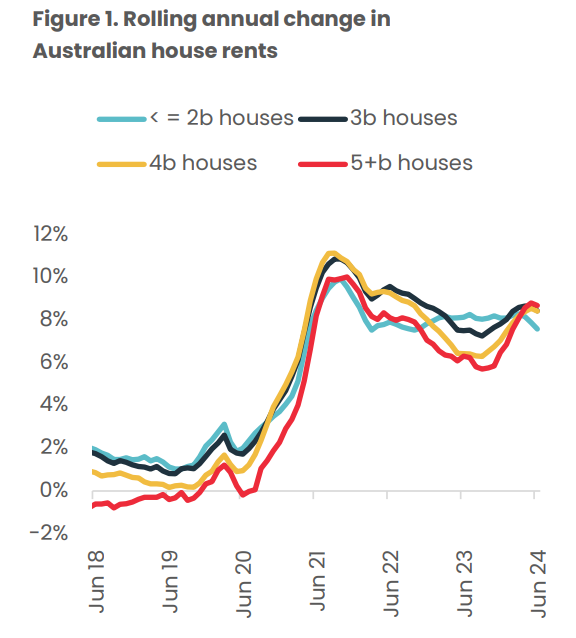
For houses, rents increased 8.4% nationally in the year to June, and this ranged from a 7.6% rise in houses with up to two bedrooms to 8.7% in larger houses with five bedrooms or more (Figure 1).
In the unit segment, which includes properties on strata titles such as townhouses and apartments, there has been an even more substantial slowdown in the rent growth of smaller dwellings.
Annual growth in one-bedroom units and studios slowed from 16.8% in the year to April 2023 (a series high), to 7.1% in the past 12 months.
This was the weakest annual growth of unit rents by bedroom count in the period.
Similarly, two-bedroom units have seen a slowdown in annual rent growth from 15.4% in the year to May 2023 to 7.9% in the past 12 months (Figure 2).
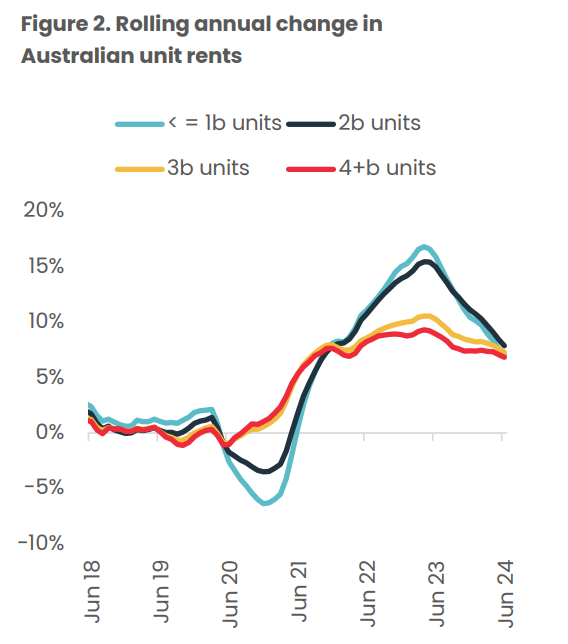
Despite the slowdown, two-bedroom units maintained the highest rent growth on a national level.
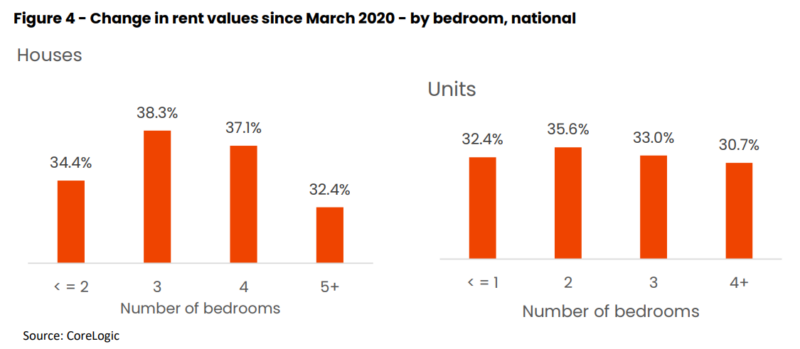
Since the onset of COVID, smaller units have seen larger movements in rent value.
This is because almost a quarter of units with one or two bedrooms in Australia are located within inner city regions of the three largest capitals, as defined by the SA4 markets of Melbourne ‘Inner’, Sydney ‘City and Inner South’ and Brisbane ‘Inner City’.
Changes in overseas migration have highly impacted rental demand in these markets.
As borders closed down, a disproportionately sharp drop in tenants from overseas (a primary source of inner-city rental demand) alongside job losses within the hospitality, tourism and arts sectors caused a pronounced decline in inner-city unit rents.
When international arrivals resumed, it meant this stock outperformed. Since early 2023, net overseas migration has gradually been trending lower since historic highs, and annual rent growth seems to be following in units with one or two bedrooms and studios.
Why are bigger dwellings popular amid a cost of living squeeze?
Interestingly, larger rental properties are showing more resilient rent growth, despite being more expensive.
Large rental properties may actually be more feasible for renters in shared situations, including reforming group households and multi-generational households.
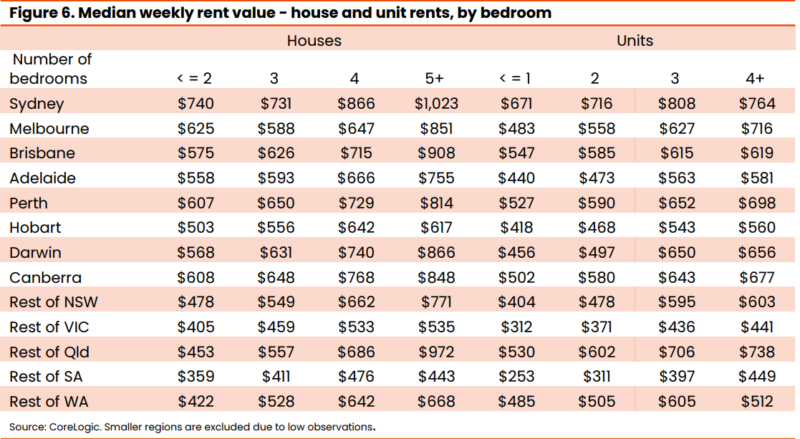
Figure 3 shows the current median weekly rent across Australia by bedroom, and divided by the bedroom count.
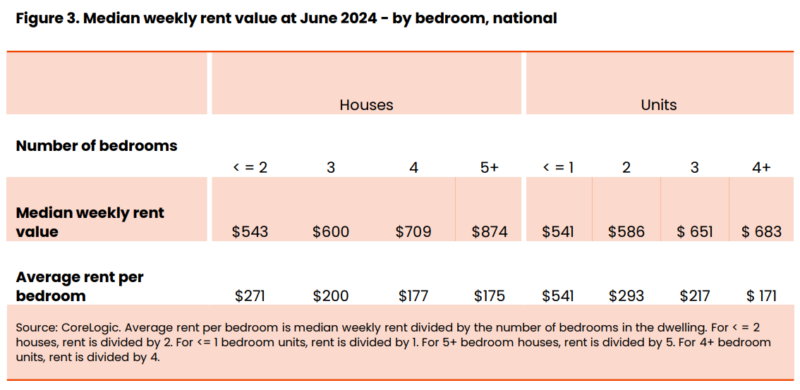
At least for the national medians, the average rent for a bedroom (i.e. total rent divided by number of bedrooms) is lower the higher the bedrooms are.
At the time of the 2021 census, group households made up a relatively small portion of living arrangements, accounting for around 3.6% of people in private dwellings.
But with most rental leases in Australia being a relatively short 12 months, rising rent costs may prompt some renters to form shared houses and seek out larger dwellings for a cheaper room rate.
Another reason annual rent growth may be higher in larger dwellings now is that it lagged earlier in the pandemic period.
The RBA highlighted a trend of shared houses breaking up and spreading out across the rental market through COVID, which may have driven popularity in smaller dwellings that offered fewer bedrooms and a home office through 2021.
Two-bedroom units saw the biggest growth in rents nationally since the start of the pandemic, as well as three-bedroom houses.
A mixed picture by region
Figures 5 and 6 show a summary of annual rent growth and value by capital city and regional market of Australia.
Despite larger houses seeing higher rent growth on a national scale, this is a trend largely led by NSW and Queensland, with Melbourne also showing distinctly higher growth in house rents with five or more bedrooms.
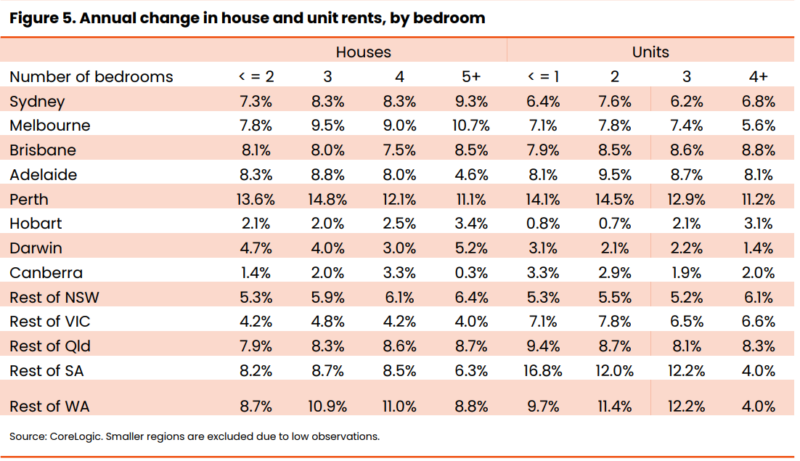
In most capital cities, two-bedroom units have sustained the highest increases in rent over the year.
Looking ahead, cities where larger house rents are underperforming, such as Perth and Adelaide, may eventually see a similar shift to higher demand for larger dwellings that can be occupied by shared households.